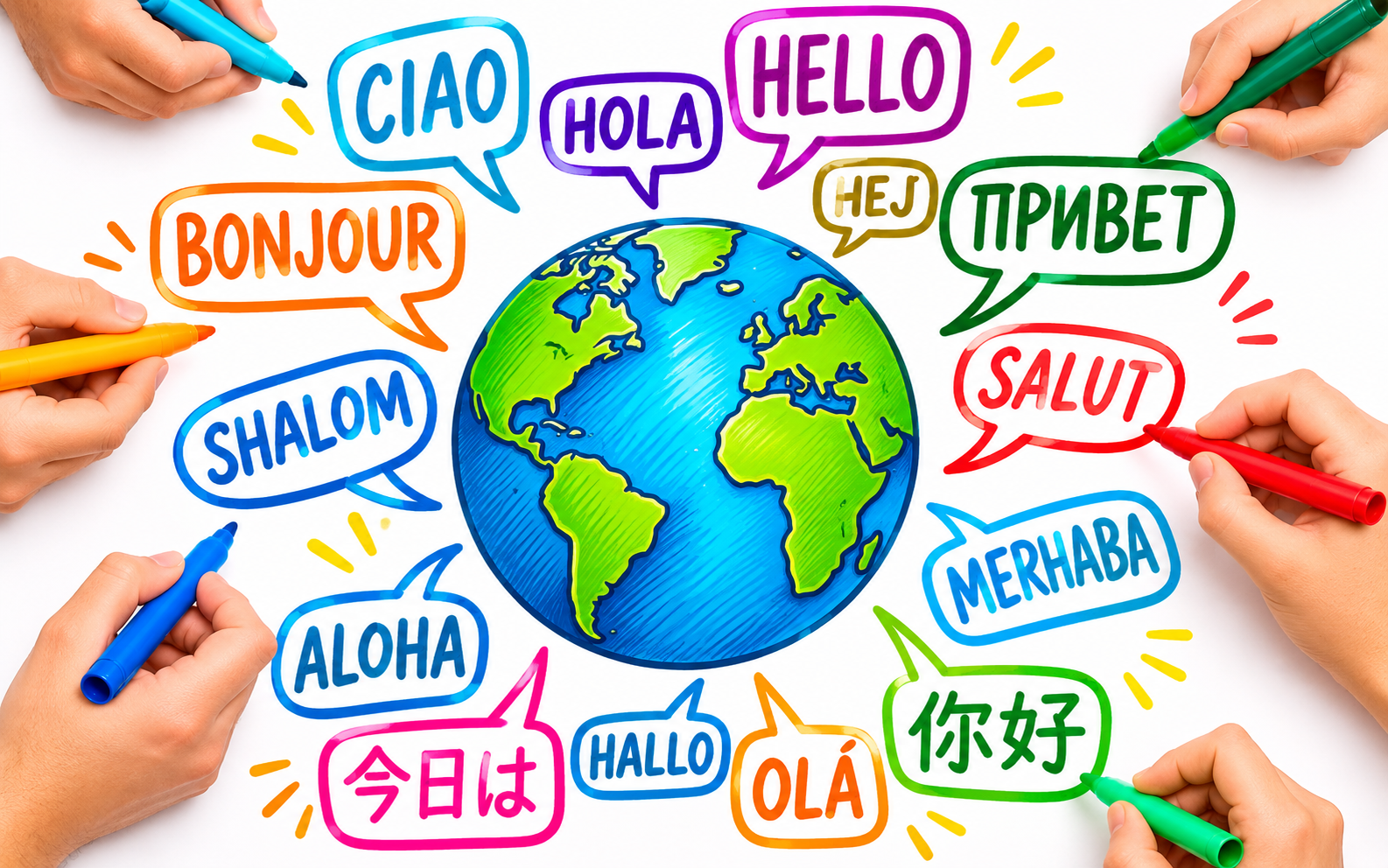
One new language. A thousand new possibilities!
Imagine walking into a café in Paris and confidently ordering your favorite pastry in French. Picture yourself watching your favorite anime in Japanese without subtitles, understanding a Spanish song without looking up the lyrics, or chatting with someone from another country in their native language.
Sounds exciting, doesn't it?
Now imagine having the ability to do all of these things!
Learning a new language isn't just about memorizing vocabulary or passing a school exam. It's about discovering new cultures, making connections, challenging your brain, and opening doors to opportunities you may never have imagined.
At Ramana Learning Center (RLC), we believe that learning should inspire curiosity, build confidence, and prepare students for a world full of possibilities.
And learning a new language is one of the most exciting ways to do just that!
🌎 1. Every Language Is a Passport to a New World
Did you know that there are more than 7,000 living languages spoken around the world?
Each language carries its own stories, traditions, expressions, and ways of seeing the world.
When you learn a language, you're not simply learning different words for familiar things. You're discovering how people communicate, celebrate, express emotions, and share ideas.
For example:
🇪🇸 Spanish: Connect with Spanish-speaking communities across the Americas, Spain, and beyond.
🇫🇷 French: Explore French literature, cinema, fashion, and cultures across several continents.
🇯🇵 Japanese: Discover Japanese traditions, anime, manga, and the fascinating ways language reflects social relationships.
🇰🇷 Korean: Understand more of your favorite K-pop songs, Korean dramas, and Korean culture.
🇩🇪 German: Explore scientific traditions, engineering, literature, and cultural history.
🇨🇳 Mandarin Chinese: Discover Chinese literature, traditions, and one of the world's most widely spoken languages.
Fun thought: What if learning just ten new words could help you start a conversation with someone you couldn't communicate with yesterday?
That's the magic of language learning!
🧠 2. Give Your Brain a Workout Without Going to the Gym!
We exercise our bodies to become stronger. But what about our brains?
Learning a language challenges your mind in interesting ways.
As you practice unfamiliar words, sounds, grammar patterns, and conversations, you're exercising skills such as attention, memory, and flexible thinking.
For example, imagine learning that a single idea can be expressed in completely different ways across languages.
English: "I am hungry."
Spanish: "Tengo hambre."
French: "J'ai faim."
The Spanish and French expressions literally use the idea of having hunger rather than being hungry.
Isn't that fascinating?
These differences encourage us to think beyond the patterns we're accustomed to.
Although learning another language doesn't automatically guarantee better grades or a higher IQ, it provides meaningful opportunities to practice concentration, recall, and problem-solving.
🎬 3. Your Favorite Movies, Music, and Games Can Become Learning Tools
Who said studying has to be boring?
What if your next language lesson involved listening to your favorite song, watching a movie, or playing a game?
Learning a new language can make entertainment even more enjoyable.
Love anime? Try learning common Japanese expressions.
Enjoy K-pop? Learn to read Hangul, the Korean writing system.
Love soccer? Explore Spanish commentary from an international match.
Enjoy international movies? Watch a familiar scene with subtitles in the language you're learning.
The best part?
You don't have to understand every word immediately.
Start by recognizing a few familiar expressions. Over time, those small discoveries can become big moments of confidence.
RLC Student Challenge: Choose a song in a language you don't know. Find five interesting words, learn their meanings, and try using them in a sentence.
✈️ 4. Travel Becomes a Whole New Adventure
Imagine visiting another country and being able to ask for directions, order food, greet someone politely, or thank a local shopkeeper in their own language.
Even a few basic phrases can make travel more meaningful.
Consider these greetings:
| Language | Hello |
|---|---|
| Spanish | Hola |
| French | Bonjour |
| Japanese | こんにちは (Konnichiwa) |
| Korean | 안녕하세요 (Annyeonghaseyo) |
| German | Hallo |
| Mandarin Chinese | 你好 (Nǐ hǎo) |
You don't need to speak perfectly to begin connecting with others.
A simple greeting, spoken respectfully, can be a wonderful first step toward a conversation.
And sometimes, the most memorable travel experiences begin with just one word!
🎓 5. Your Future Self Might Thank You!
Students often wonder:
"Will I ever use this subject in real life?"
With languages, the possibilities are easy to imagine.
Communication skills can be valuable in many careers, including:
Medicine and healthcare
Engineering and technology
International business
Education and research
Journalism and media
Travel and hospitality
Diplomacy and public service
Knowing another language may help you communicate with more people, explore international opportunities, and work effectively in diverse environments.
Language learning can also demonstrate curiosity, persistence, and commitment—qualities that matter in school, college, and beyond.
Remember, you don't need to know exactly what career you want today to start building a skill that could be useful tomorrow.
💬 6. Mistakes Are Part of the Adventure!
Here's a secret that successful language learners discover:
You don't have to be perfect to make progress.
You might pronounce a word incorrectly.
You might forget a grammar rule.
You might accidentally say something funny!
And that's okay.
Every mistake gives you an opportunity to learn.
Think about how children learn their first language. They experiment, repeat words, ask questions, and gradually become more confident.
Learning another language works best when you give yourself permission to practice.
Instead of asking, "What if I make a mistake?"
Try asking, "What new word can I learn today?"
Confidence grows through consistent effort—not perfection.
🚀 7. The 15-Minute Language Challenge
Want to start learning a new language but don't know where to begin?
Here's a simple daily routine.
| Time | Your mission |
|---|---|
| 3 minutes | Learn three new words |
| 4 minutes | Listen to a short conversation or song |
| 3 minutes | Practice speaking aloud |
| 3 minutes | Write two simple sentences |
| 2 minutes | Review yesterday's vocabulary |
Total: Just 15 minutes a day!
That's a manageable way to begin building a learning habit.
Over 30 days, learning three words daily could introduce you to 90 new vocabulary words!
Of course, remembering and using those words takes review and practice, but small daily steps can create real momentum.
Bonus Challenge: Can You Say “Thank You” in Five Languages?
🇪🇸 Spanish: Gracias
🇫🇷 French: Merci
🇯🇵 Japanese: ありがとう (Arigatō)
🇰🇷 Korean: 감사합니다 (Gamsahamnida)
🇩🇪 German: Danke
Try saying all five aloud!
Now challenge a friend or family member to learn them too.
🌟 8. Which Language Should You Learn First?
Here's the exciting part: There isn't one perfect language for everyone.
The best language to start with is often the one that makes you curious enough to keep learning.
Ask yourself:
Do I want to connect with relatives or friends who speak another language?
Is there a country I'd love to visit?
Do I enjoy music, movies, or books from a particular culture?
Would another language help me explore a future career?
Which language am I genuinely excited to practice?
Your motivation matters.
When you're interested in what you're learning, you're more likely to return to it, even when the lessons become challenging.
❤️ Learning Languages Also Teaches Us to Understand Each Other
Perhaps one of the most meaningful benefits of language learning has nothing to do with vocabulary tests or grammar exercises.
It's learning to appreciate people whose experiences may be different from our own.
Every language has a history.
Every culture has stories worth hearing.
Every conversation offers a chance to learn something new.
When students explore other languages, they can also develop a deeper appreciation for the diversity of the world around them.
And in an increasingly connected world, that curiosity and respect are valuable qualities.
🎯 Your Language-Learning Journey Starts Today!
You don't need an expensive plane ticket, a perfect accent, or hours of free time to begin.
You just need curiosity, consistency, and a willingness to try.
Start with one greeting.
Learn three new words.
Listen to a song.
Practice a short conversation.
Celebrate every small improvement.
Because every new language you learn gives you another way to connect with the world.
At Ramana Learning Center, we believe education is about more than mastering subjects—it's about building confidence, encouraging curiosity, and helping students discover their potential.
So, here's our challenge to you:
If you could wake up tomorrow speaking any language fluently, which one would you choose—and why?
Share your answer with a friend, a parent, or a teacher. Your next great learning adventure might begin with that conversation!
Ramana Learning Center (RLC)
Your Success Is Our Passion
🌐 www.ramanalearningcenter.com